Product · how to play
How to play Inkwash
Inkwash is a block puzzle with eight ways to play. You drag pieces from a tray onto the board and clear full rows and columns. Each mode adds one twist to that idea: rising ink, a turning board, ink that bleeds, a growing multiplier, two-layer cells, joined edges or flipping stamps.
The basics, in five steps
Every mode starts the same way. The board is empty and a tray of three pieces waits below it.
Look at the tray
Each piece is a small shape of tiles, and each colour has its own mark. You can read the pieces without telling colours apart.
Drag a piece onto the board
Place it where it fits. When all three pieces are placed, a fresh tray of three arrives.
Clear rows and columns
A full row or a full column clears. Clearing more than one line with a single piece, or chaining clears in a row, scores more.
Watch for the twist
In every mode except Classic, one rule changes the board as you play. The first time you play a mode, a short picture guide shows it.
The run ends when nothing fits
When no piece in the tray fits, the run is over and the end-of-run card shows your score, your ink and your brush rank.
The eight modes, one by one
Classic
The pure puzzle, no twist. Clear rows and columns and chain combos. It is the way to learn the board before you try the others.
Tide
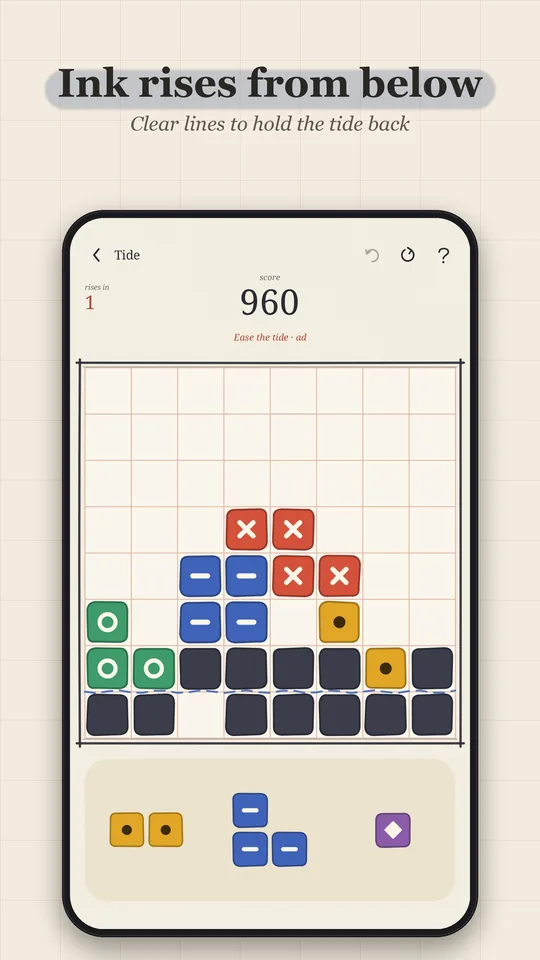
Ink rises from below. Clear lines to hold it back. Every few moves a row of dark ink rises from the bottom, and clearing lines keeps it from filling the board.
A counter on the screen shows the moves until the next rise. An optional ad can ease the tide by clearing the bottom row.
Turn
The whole board turns every few moves. Plan with the next turn in mind, because the shape you build is about to be rotated.
A counter on the screen shows the moves until the next turn.
Bleed
A cleared line also clears the connected ink of the same colour. One good line can take a whole connected patch with it, so keep colours together.
Bloom
Clear lines over seeds to grow a score multiplier. The multiplier is shown beside your score and grows as you clear lines over seeds.
Glaze
Cells hold two layers, and a full line peels one. A cell with a second layer needs two clears before it is empty.
Wrap
The edges join, so pieces can wrap around. A piece can cross one edge of the board and come back in on the other side.
Stamp
Pieces flip cells: empty cells become full and full cells become empty. Make the most of 24 stamps.
The screen shows how many stamps are left.
Scrolls, seals and the Journal
The puzzle is the same in every mode. Around it Inkwash keeps a small, quiet record of your play.
Daily Scroll and Weekly Scroll
A Daily Scroll is a puzzle with its own goal that uses the same pieces for everyone that day. You can earn up to three stars. A Weekly Scroll is the weekly version, with harder star goals. In a scroll, using an undo costs the third star, and the label says so.
Seals, ink and brush rank
Seals are small awards for things like clearing your first line, clearing two lines with one piece, chaining clears, or trying every mode. Finished games earn ink, ink raises your brush rank, and ranks open new papers for the board.
The Journal and the gallery
The Journal shows your seals, your stats and your papers. The gallery keeps the final board of your runs as small ink paintings, and you can share one from the system share sheet.
Reminders
Reminders are optional and quiet: never more than 4 a week, and never at night. You choose whether to turn them on.
Ads and optional helps
Inkwash contains ads. A few helps are offered through an ad that you choose to watch: an extra undo, continuing after a finished game, easing the tide in Tide mode, doubling the ink at the end of a run, and a gold frame for a painting. None of them is required to play, and no ad protects a streak or blocks your progress. One undo per run comes without an ad.
Play Inkwash
Ready to try a mode? Inkwash is on Google Play, and each mode explains itself the first time you play it.